
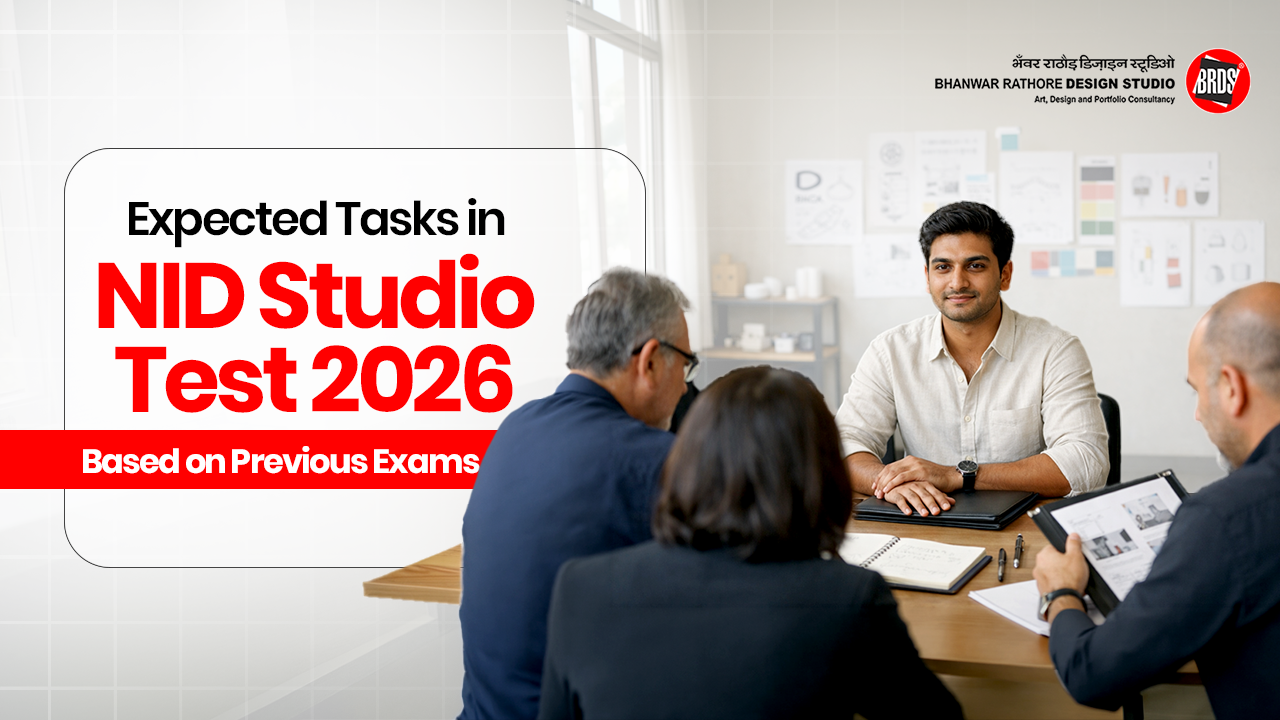
Expected Tasks in NID Studio Test 2026 Based on Previous Exams
Posted On: 08 April 2026 | 02:19:pm
Based on previous exams, the NID Studio Test includes activities like model making, sketching, storytelling, and creative problem-solving — designed to test how you think, imagine, and create under time pressure.
As a student, this is your moment. It’s not just about marks, it’s about showing your ideas, your style, and your creativity. The more you know what to expect, the more confident you’ll feel walking in.
Let’s explore this blog to discover how you can prepare effectively, build confidence, and let your creativity truly speak for itself.
Expected Tasks in NID Studio Test 2026
If we look at the trends from previous NID Entrance Exams, the NID Studio Test follows a pattern of core task categories that every student should prepare for strategically.
1. Model Making
What it involves: You will be given materials — paper, cardboard, foam, wire, or clay — and asked to build a 3D structure representing a concept, object, or idea within a strict time limit.
What examiners look for:
- Structural thinking and 3D spatial reasoning
- Innovative and functional use of materials
- Clean finishing and time management
2. Doodling / Sketching
What it involves: Freehand illustrations exploring a given theme — drawn from memory, imagination, or observation. These tasks test your visual language, confidence in line, and ability to tell a story visually.
What examiners look for:
Originality of concept and composition
Confident and expressive mark-making
Ability to depict abstract ideas visually
3. Situation-Based Problems
What it involves: A real-world or hypothetical scenario where you must design a product, system, or solution with clear reasoning and visual communication. Past prompts have included designing for differently-abled users, rural communities, and futuristic environments.
What examiners look for:
Empathy-driven and user-centred thinking
Logical and creative problem-solving approach
Clear visual and verbal communication of solution
4. Creativity & Observation Tests
What it involves: Pattern recognition, visual storytelling from abstract prompts, memory-based recall tasks, or interpreting ambiguous stimuli in a unique, logical, and creative way.
What examiners look for
Keen observation and attention to detail
Imagination applied with structure and logic
Unique perspective while staying relevant to the brief
5. Material Manipulation
What it involves: Using given materials — wire, foam, clay, newspaper, fabric — to create a functional or expressive form. This tests your tactile intelligence and hands-on creative thinking.
What examiners look for
Understanding of material properties and limitations
Innovative repurposing and creative construction
Neat execution under time constraints
Skills Required to Crack the NID Studio Test
Success in the Studio Test is built on a combination of mental agility and practical capability. Here are the six core skills you need to develop:
- Spatial reasoning — visualising objects in 3D and translating ideas into physical form
- Visual communication — expressing complex ideas clearly through sketches, diagrams, or models
- Lateral thinking — finding unexpected, functional, and elegant solutions to open-ended prompts
- Material awareness — understanding the properties of paper, clay, wire, foam, and common craft materials
- Time management — delivering a complete, considered response within strict time constraints
- Self-confidence under pressure — staying calm, committing to your idea, and executing it decisively
Preparation Tips for Nid Studio Test 2026
Here are six practical, realistic ways to prepare for the NID Studio Test:
1. Build a daily sketching habit
Spend 20–30 minutes daily drawing objects, people, and environments from observation. Focus on quick, confident lines rather than perfectionism. The goal is fluency, not precision.
2. Practice timed model making
Set a 30-minute timer and build something — anything — from newspaper, tape, and wire. The material is less important than the discipline of completing a task within a fixed limit.
3. Engage with design around you
Actively notice and analyse the design of everyday objects. Ask why something is shaped the way it is, who it’s designed for, and how it could be improved. This sharpens your design vocabulary faster than any textbook.
4. Work on random prompts regularly
Pick a random object and a random user group and design something for them. This is the closest simulation of what the NID Studio Test actually feels like — and it trains you to think fast and commit.
5. Seek structured feedback
Working independently has limits. Structured NID coaching environments expose you to critique, peer comparison, and expert feedback that dramatically accelerates growth — particularly in areas like composition, idea development, and presentation clarity.
6. Simulate the real environment
Practice in silence, with a timer, on a desk with only the materials you’ll be given. Mental preparation for the physical setting reduces anxiety on the actual day and lets your creative mind take over.
Final Verdict
Every candidate who walks into that room carries nerves, self-doubt, and excitement all at once. What separates those who succeed is not talent alone, it’s consistent, deliberate preparation. Understand the tasks. Practice across all formats. Trust your instincts. And remember: the examiner isn’t looking for a finished product. They’re looking for a designing mind at work. You have what it takes now to prove it.
More Blogs

Location Direction

BRDS, 100 (Building), First Floor, Nr. Rajvi Arcade & Sankalp Restaurant, Drive-In Road, Ahmedabad, Gujarat, India

