
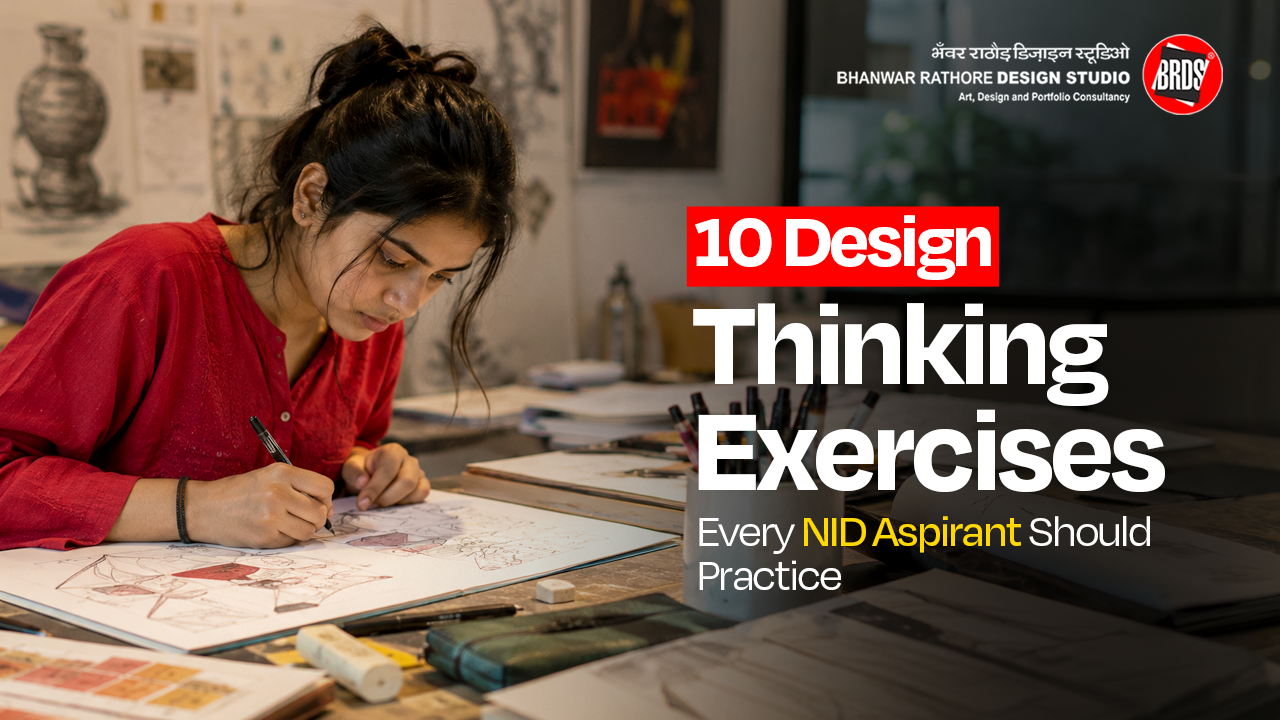
10 Design Thinking Exercises Every NID Aspirant Should Practice
Posted On: 29 July 2026 | 01:11:pm
Success in the NID entrance exam isn’t determined by drawing ability alone. Every year, the National Institute of Design looks for students who can observe carefully, think creatively, solve problems, and communicate ideas effectively; the core of what IDEO calls design thinking: a human-centred approach to innovation, not an artistic one.
The encouraging news is that design thinking is a skill you can develop with regular practice. A few simple exercises, when practised consistently, can significantly improve your observation, creativity, and problem-solving abilities for the NID entrance exam.
Here are ten exercises worth adding to your prep routine; none require perfect sketches, just consistent thinking.
1. Observe Everyday Objects Like a Designer
Designers don’t just use products; they question them. Pick a water bottle, chair, or school bag and study who uses it, what problem it solves, and how it could improve. Observation and product-improvement tasks are a recurring theme in NID papers, where candidates must analyse everyday situations and communicate solutions rather than simply draw well.
Try It Yourself
Select one everyday object from your study table or home.
- Within 20 minutes, complete the following:
- Write 5 positive features of the product.
- Identify 5 user problems.
- Think of 3 different users (for example, a school student, a traveler, and an elderly person).
- Sketch 2 improved versions based on their different needs.
Don’t worry about making perfect drawings; focus on communicating your ideas clearly.
Skills You Develop
- Observation
- User Empathy
- Design Thinking
- Product Analysis
- Creativity
- Visualisation
- Problem Solving
Why This Exercise Matters for NID
NID searches for candidates who can observe the world with curiosity, understand users, and generate thoughtful solutions to real-life problems. By practising this exercise regularly, you’ll gradually begin to think like a designer rather than simply draw like one, a mindset that plays a crucial role in both the NID entrance exam and a successful design career.
2. Redesign an Everyday Product
Design thinking often starts by asking “how can this work better?” rather than inventing something new. The official NID DAT B.Des Sample Paper 2026 includes exactly this task: draw an object, explain a key function, then sketch an improved version.
Previous NID Connection
The official NID DAT B.Des Sample Paper 2026 includes a task where candidates first draw an object, explain one of its key functions for the user, and then suggest an improvement to its functionality by drawing an improvised version.
Try It Yourself
Choose any one everyday product and redesign it for a different user.
For example:
- A school bag for primary school children that reduces shoulder strain.
- A water bottle for senior citizens with an easier grip and spill-proof cap.
- A toothbrush for users with limited hand mobility.
- A bus stop designed to improve accessibility for wheelchair users.
Support your idea with a quick sketch and briefly explain how your redesign improves the user’s experience.
Skills Developed
- User-centred Design
- Problem Solving
- Creativity
- Product Improvement
- Empathy
- Functional Thinking
3. The “10 Ideas in 10 Minutes” Challenge
Designers rarely stop at their first idea. Instead, they explore multiple possibilities before selecting the strongest solution. This process, known as ideation, is a key stage of design thinking and helps encourage originality.
Choose a simple design problem, such as “How can students carry books more comfortably?” or “How can waiting at a bus stop become more engaging?” Set a timer for 10 minutes and write or sketch 10 different solutions. Don’t worry if some ideas seem unusual; creative thinking often begins with quantity before quality.
Previous NID Connection
NID DAT regularly includes open-ended design problems that assess originality, flexibility of thinking, and idea generation under time constraints.
Try It Yourself
Pick one everyday problem and challenge yourself to create 10 unique ideas in 10 minutes. Once you’re done, select the most practical solution and explain why it works best for the user.
Skills Developed
- Ideation
- Creativity
- Divergent Thinking
- Problem Solving
- Time Management
4. Think in Reverse to Discover Better Solutions
Instead of asking, “how can I improve this?” ask, “how could I make this worse?” – a technique called “reverse brainstorming,” closely related to the problem-framing stage in the Design Council’s Framework for Innovation. Sharp edges, an unstable base, no back support; then reverse each flaw into a fix. NID’s open-ended problems reward exactly this kind of lateral analysis.
For example, imagine making a chair uncomfortable:
- Add sharp edges.
- Make the legs unstable.
- Remove the back support.
- Use slippery material.
Now reverse each idea to create a better design: rounded edges, a stable base, proper back support, and comfortable materials. Looking at problems from the opposite perspective often leads to practical and innovative solutions.
Previous NID Connection
NID frequently presents open-ended design problems that require candidates to analyse existing situations, identify shortcomings, and develop creative improvements. Reverse thinking is an effective way to generate original ideas when solving such questions.
Try It Yourself
Choose any everyday product and list five ways to make it worse. Then reverse each point to create a smarter, more user-friendly design.
Skills Developed
- Creative Thinking
- Problem Analysis
- Innovation
- Design Thinking
- Idea Generation
5. Tell a Story Through Sketches
Design is about communicating ideas, not just creating attractive drawings. One of the best ways to improve this skill is through visual storytelling; using a sequence of sketches to explain a situation, a problem, and its solution without relying on lengthy text.
Create a six-frame storyboard based on an everyday scenario, such as losing a school ID card, carrying groceries, travelling during heavy rain, or helping an elderly person cross the road. Show the problem, the user’s experience, your solution, and the outcome.
Previous NID Connection
Storyboard and sequential sketching tasks have appeared in NID entrance examinations, where candidates are asked to communicate ideas, emotions, or everyday situations through a series of visuals. These questions assess visual communication, observation, creativity, and the ability to express a complete idea clearly, not artistic perfection.
Try It Yourself
Choose one real-life situation and create a six-frame storyboard showing:
- The problem
- The user’s challenge
- Your design solution
- The final outcome
Keep each sketch simple and focus on communicating the story clearly.
Skills Developed
- Visual Communication
- Storytelling
- Observation
- Creativity
- Sequential Thinking
6. Conduct a Mini User Interview
Good design begins with understanding people, not products. Before solving a problem, designers first learn about users’ needs, challenges, and daily experiences. This process is called user research and is a key part of design thinking.
Speak to a parent, grandparent, classmate, shopkeeper, or neighbour and ask simple questions like
- What everyday problem frustrates you the most?
- Why is it difficult?
- How do you currently solve it?
- If you could change one thing, what would it be?
Previous NID Connection
NID frequently presents user-centred design problems where candidates must understand people’s needs and propose practical solutions. Developing empathy through observation and conversation helps you approach such questions more thoughtfully.
Try It Yourself
Interview two different people about the same everyday problem. Compare their answers and identify one design opportunity that could improve their experience.
Skills Developed
- User Empathy
- Observation
- Research Skills
- Problem Identification
- Design Thinking
7. Improve Something Around You
Design opportunities are everywhere; a cluttered study table, a confusing notice board, a crowded shoe rack. NID often bases problems on exactly these everyday environments.
Previous NID Connection
NID frequently includes problem-solving questions based on everyday environments, where candidates are expected to observe existing situations, identify user challenges, and propose practical, creative improvements through sketches and brief explanations.
Try It Yourself
Choose one everyday space and answer these questions:
- What is the problem?
- Who is affected?
- Why does it happen?
- Sketch one simple redesign that makes the space easier to use.
Skills Developed
- Observation
- Problem Solving
- Spatial Thinking
- User-Centred Design
- Creativity
8. Draw What You See, Not What You Think
Observation drawing trains accuracy, proportion, and attention to detail: skills every NID studio task rewards. Sketch a real object (shoe, cup, backpack) from direct observation, not memory or a photo.
Previous NID Connection
Observation-based sketching has been a recurring component of NID entrance preparation, where candidates are expected to communicate ideas clearly through quick, accurate sketches. The emphasis is on careful observation and visual communication rather than artistic perfection.
Try It Yourself
Pick one everyday object and sketch it from three different angles within 15 minutes. Compare your sketches with the actual object and identify details you initially overlooked.
Skills Developed
- Observation
- Sketching
- Perspective
- Proportion
- Visual Communication
9. Communicate an Idea Without Words
Designers often communicate visually before using text. Pick a theme, saving water or road safety, and explain it using only sketches and symbols, no words. NID’s concept-expression tasks assess exactly this clarity of thought.
Previous NID Connection
Visual communication and concept-expression tasks are common in NID entrance examinations, where candidates are expected to convey ideas clearly through sketches, symbols, and illustrations. These questions assess clarity of thought, creativity, and communication rather than artistic perfection.
Try It Yourself
Pick one social message and create a four- or six-frame visual sequence that communicates the idea using only sketches. Ask a friend or family member to interpret your drawings. If they understand the message without any explanation, you have communicated effectively.
Skills Developed
- Visual Communication
- Creativity
- Storytelling
- Concept Development
- Design Thinking
Once you can communicate ideas visually, the final step is bringing together observation, creativity, empathy, and problem-solving to tackle complete design challenges under time constraints.
10. Build Quick Prototypes
Great designers build simple models to test ideas rather than waiting for perfection. Many NID challenges reward candidates who think beyond flat sketches toward how an idea would actually function.
Previous NID Connection
Many NID design challenges encourage candidates to think beyond sketches and consider how ideas would function in the real world. Developing the habit of building simple prototypes helps strengthen problem-solving and practical design thinking.
Try It Yourself
Choose one idea from the previous exercises and create a simple prototype using household materials like paper, cardboard, or clay to build a rough model of an earlier idea. Show it to a friend or family member, ask for feedback, and make one improvement based on their suggestions.
Skills Developed
- Prototyping
- Design Thinking
- Creativity
- Problem Solving
- Iteration
Final Takeaway: These exercises aren’t just preparation techniques; they help you develop the observation, creativity, empathy, and problem-solving mindset that NID looks for in aspiring designers. Practise them consistently, and you’ll gradually begin to think like a designer, not just draw like one
Why These Exercises Matter
Design thinking is a skill that develops through consistent practice, not memorisation. These exercises help you build the core abilities that NID evaluates throughout its entrance process, including:
- Observation and visual analysis
- Creativity and idea generation
- User-centred problem-solving
- Visual communication and storytelling
- Empathy and design research
- Sketching and concept development
- Time management under exam conditions
More importantly, they train you to approach everyday situations with curiosity, analyse problems from different perspectives, and communicate practical solutions, exactly the mindset expected in the NID entrance exam.
FAQs
More than just sketch quality, originality and reasoning usually matter more than polish.
Yes, most are self-directed; only the interview exercise needs another person.
Yes, storyboarding, prototyping, and reverse brainstorming map directly onto Studio briefs.
Same exercises, deeper reps, full prototypes, and longer interviews instead of quick, timed versions.
Track idea count over time, not sketch quality; more ideas per session is the real signal.
More Blogs

Location Direction

BRDS, 100 (Building), First Floor, Nr. Rajvi Arcade & Sankalp Restaurant, Drive-In Road, Ahmedabad, Gujarat, India

