
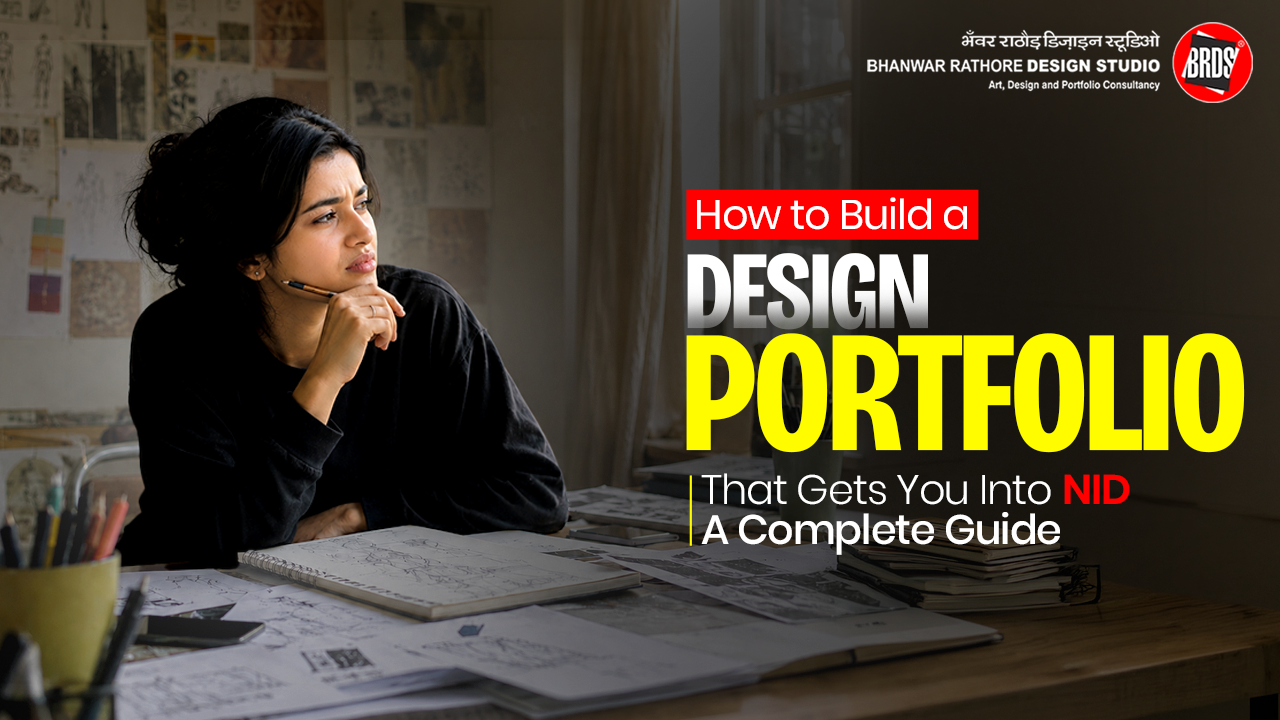
How to Build a Design Portfolio That Gets You Into NID: A Complete Guide
Posted On: 20 July 2026 | 01:09:pm
Many NID aspirants believe a strong portfolio is all about flawless sketches or impressive artwork. In reality, the National Institute of Design (NID) looks beyond artistic perfection. It values creativity, observation, design thinking, problem-solving, and your ability to communicate ideas through a clear design process.
Whether you’re preparing for NID DAT or just beginning your design journey, building a thoughtful portfolio helps you develop the very skills NID looks for. In this blog, you’ll learn what makes a standout NID portfolio, what to include, common mistakes to avoid, and practical tips to showcase your creative thinking with confidence.
Does NID Require a Portfolio?
A portfolio is not a mandatory submission during the initial stages of NID B.Des. admissions; creating one is highly beneficial as it helps you:
- Strengthen the creativity, observation, visualisation, communication, and problem-solving skills evaluated in the NID selection process.
- Develop a structured design process by documenting research, ideation, prototyping, and refinement.
- Prepare confidently for studio discussions, interviews, and future portfolio reviews.
- Build a collection of original projects that can also support applications for internships, scholarships, higher education, and design careers.
The NID Admissions Handbook 2026–27 emphasises that selection is based on design aptitude, creativity, observation, visualisation, communication, and problem-solving, not artistic perfection. A thoughtfully built portfolio helps you develop and showcase these qualities naturally.
Now that you know why a portfolio matters, let’s look at the qualities that make one truly stand out.
What Makes a Strong NID Portfolio
A strong NID portfolio isn’t judged by artistic perfection alone. Instead, it should demonstrate the same qualities that NID evaluates during the Design Aptitude Test (DAT), including creativity, observation, visualisation, communication, and problem-solving.
Rather than focusing only on polished final outcomes, show how you think, explore ideas, and develop solutions. A strong portfolio should demonstrate:
- Observation & Empathy: Notice user needs, behaviours, and everyday challenges that inspire meaningful design solutions.
- Creativity & Original Thinking: Develop original ideas through your own thinking rather than relying on trends or copied references.
- Problem-Solving Ability: Show how you identify challenges, explore alternatives, and create thoughtful, user-centered solutions.
- Design Process: Include research, brainstorming, sketches, iterations, prototypes, and refinements instead of displaying only the final outcome.
- Visual Communication: Present your ideas clearly through sketches, diagrams, annotations, layouts, and visual storytelling.
- Experimentation & Exploration: Demonstrate your willingness to explore different materials, techniques, and creative approaches before reaching a final solution.
- Reflection & Learning: Explain what you learned from each project, how feedback influenced your work, and how your ideas evolved.
- Presentation & Organisation: Organise your portfolio logically so reviewers can easily follow your creative journey.
Remember, reviewers are interested in how you think as much as what you create. A portfolio that clearly communicates your creative process and problem-solving approach will always make a stronger impression than one filled only with polished visuals.
Build Your Portfolio Around Real-World Design Challenges
A strong NID portfolio should be built around solving real-world problems, not simply showcasing attractive artwork. Design begins with understanding people, identifying their needs, and creating solutions that improve everyday experiences.
Instead of asking, “What can I draw?” ask yourself, “What problem can I solve?” Projects inspired by real-life observations demonstrate creativity, empathy, and problem-solving skills; qualities NID values in aspiring designers.
Look around your surroundings for everyday challenges, such as:
- How can a school bag reduce strain on students carrying heavy books?
- How can public seating be made more comfortable for senior citizens?
- How can household products be redesigned to reduce plastic waste?
- How can classroom furniture improve learning and collaboration?
- How can everyday packaging become easier to open, store, or recycle?
As you work on each project, document how your idea evolves through observation, research, ideation, prototyping, testing, and refinement.
This is one example of the human-centered design process that professional designers use in product, communication, service, and interaction design. More than that, it also demonstrates the curiosity, observation, creativity, analytical thinking, and problem-solving ability that design institutes seek in their prospective students.
The next step is to present that journey clearly so reviewers understand not just what you designed but also how you arrived at your solution.
Essential Components of a Well-Rounded NID Portfolio
An effective portfolio isn’t about including everything you have ever created. Instead, focus on a selection of projects that best demonstrate your creativity, observation, design thinking, and problem-solving abilities.
Rather than filling your portfolio with unrelated sketches or finished artworks, choose projects that tell a complete story. Each project should answer six questions:
✔ What problem did I identify?
✔ What research did I do?
✔ What ideas did I explore?
✔ How did my design evolve?
✔ Why did I choose this solution?
✔ What did I learn?
A smaller portfolio with thoughtful, well-documented projects often creates a stronger impression than a large collection of unrelated work.
To showcase a well-rounded skill set, consider including a mix of the following project types:
| Type of Work | What It Demonstrates |
| Observation Sketches | Attention to detail, proportions, human behaviour, and everyday surroundings. |
| Product or Service Redesign | Ability to identify user problems and develop practical design solutions. |
| Branding, Packaging, or Graphic Design | Visual communication, typography, layout, colour application, and conceptual thinking. |
| Storyboards or Visual Narratives | Ability to communicate ideas, user journeys, and experiences through visuals. |
| Photography | Observation, composition, storytelling, and documenting people or environments. |
| Models, Mock-ups, or Prototypes | Hands-on experimentation and the ability to translate ideas into tangible solutions. |
| Material Exploration | Curiosity to experiment with different materials and understand their properties. |
| Sustainable or Social Design Projects | Awareness of environmental or social challenges and responsible design thinking. |
| Personal Passion Projects | Originality, initiative, and genuine interest beyond classroom assignments. |
Whatever projects you choose, don’t showcase only the finished outcome. Include your research, brainstorming, sketches, iterations, prototypes, user feedback, and design decisions to reveal how your ideas evolved. If you use digital tools, balance them with hand sketches and process documentation to demonstrate versatility and independent thinking.
Ultimately, your portfolio should answer one question for the reviewer: How do you observe, think, experiment, and solve design problems?
Show Your Design Process
Instead of showcasing only the final design, show how your idea evolved from identifying the problem to researching, exploring concepts, prototyping, and refining the solution. NID values your design thinking and problem-solving process as much as the final outcome.
| Design Stage | What to Include | Why It Matters |
| Problem Identification | Clearly define the challenge or user need you observed. | Demonstrates curiosity, empathy, and your ability to recognise real-world design opportunities. |
| Research & Observation | User observations, interviews, photographs, notes, competitor analysis, or contextual research. | Shows that your design decisions are informed by evidence rather than assumptions. |
| Idea Exploration | Brainstorming, mind maps, thumbnail sketches, alternative concepts, and rough layouts. | Reflects creative thinking and your willingness to explore multiple possibilities before selecting one direction. |
| Concept Development | Refined sketches, annotations, material choices, or design iterations. | Illustrates how your ideas evolved through experimentation and critical evaluation. |
| Prototype or Mock-up | Paper models, physical prototypes, digital mock-ups, or simple usability tests. | Demonstrates practical problem-solving and your ability to test ideas before finalising them. |
| Final Solution | The completed design supported by visuals, renders, or photographs. | Presents your most refined response while connecting it to the original problem. |
| Reflection & Learning | Challenges faced, feedback received, improvements made, and what you would do differently next time. | Shows self-evaluation, adaptability, and a growth mindset valued in design education. |
A clear design process helps reviewers understand the thinking behind your work, not just the final outcome. However, even strong projects can lose their impact if they’re presented poorly or include common avoidable mistakes. Before finalising your portfolio, it’s worth knowing what to avoid.
Mistakes That Can Weaken Your NID Portfolio
Even students with strong creative potential can undermine their portfolio by making a few avoidable mistakes. A portfolio should not only showcase your creativity but also communicate your ability to observe, analyse, experiment, and solve design problems. Before finalising your portfolio, review it carefully to ensure it avoids the following pitfalls.
| Common Mistake | Why It Can Reduce the Impact of Your Portfolio |
| Copying ideas from Pinterest, Behance, or social media | Your projects should reflect your independent thinking, ideas, and design decisions. |
| Showing only final designs | Without sketches, research, iterations, or prototypes, reviewers cannot understand how your ideas developed or how you approached the design challenge. |
| Including repetitive work | Multiple projects that demonstrate the same skill add little value. A diverse portfolio better reflects your versatility and creative range. |
| Prioritising aesthetics over problem-solving | Attractive visuals alone are not enough. Every project should solve a clear user need or design challenge. |
| Weak research and observation | Projects based on assumptions rather than real observations often lack depth and credibility. User research, field observations, or contextual understanding strengthen design decisions. |
| Poor presentation and organisation | Inconsistent layouts, cluttered pages, unreadable text, or low-quality photographs make it difficult for reviewers to understand your work. Good visual hierarchy improves communication. |
| Explaining too little or too much | Excessive text can overwhelm the reviewer, while insufficient explanation can make your ideas unclear. Aim for concise annotations that support your visuals. |
| Ignoring reflection and learning | Design is an iterative discipline. Showing how feedback, testing, or experimentation improved your work demonstrates maturity and a willingness to learn. |
Before submitting your portfolio, ask yourself these questions:
- Does every project solve a genuine problem or address a clear user need?
- Have I documented my research, sketches, iterations, and final solution?
- Does each project demonstrate a different skill or perspective?
- Is the portfolio visually organised and easy to navigate?
- Does the portfolio reflect my own thinking rather than trends or copied styles?
A thoughtful, well-organised portfolio that communicates your creative process and originality will always leave a stronger impression than a portfolio filled with polished visuals but little evidence of design thinking.
Physical or Digital Portfolio: Which Should You Build?
Today, most design aspirants maintain a digital portfolio, while many also keep a physical version of selected projects. Both formats have their advantages, and one does not replace the other.
| Physical Portfolio | Digital Portfolio |
| Ideal for studio reviews, coaching feedback, and exhibitions. | Easy to share for internships, competitions, scholarships, and future applications. |
| Showcases original sketches, models, and material explorations. | Supports high-quality images, videos, and detailed process documentation. |
| Allows reviewers to examine textures, prototypes, and handmade work closely. | Easy to update, organise, and access from anywhere. |
| Demonstrates craftsmanship and presentation skills. | Convenient to share through PDFs, cloud links, or portfolio websites. |
Regardless of the format, your portfolio should present your design journey clearly from research and observation to ideation, prototyping, and the final outcome. It should be:
- Easy to navigate
- Visually consistent
- Organised project by project
- Supported by concise annotations and process documentation
- Updated regularly as your skills improve
For most NID aspirants, maintaining both a physical and digital portfolio is the most practical approach. A physical portfolio is valuable for studio discussions and mentor feedback, while a digital portfolio makes it easier to share your work and continue building your professional
The Role of Expert Mentorship in Portfolio Development
Building a design portfolio independently is possible, but expert guidance can help refine both your work and your design thinking. Through regular feedback, mentors encourage students to observe more closely, explore multiple ideas, and communicate their design decisions with greater clarity and confidence.
This approach aligns with the AICTE Model Curriculum, which emphasises experiential learning, project-based learning, continuous feedback, mentoring, and problem-solving as essential components of higher education.
A structured coaching programme can support portfolio development through:
- Portfolio reviews to identify strengths and areas for improvement.
- Design thinking exercises to strengthen problem-solving and user-centered thinking.
- Creative workshops that encourage experimentation with ideas, materials, and techniques.
- Sketching and visual communication to present concepts more effectively.
- Project selection and presentation to curate a balanced, well-structured portfolio.
- Mock interviews and studio discussions to build confidence in explaining your design process and decisions.
The goal of mentorship is not to create identical portfolios but to help each student develop an original body of work that reflects their creativity, design thinking, and individual strengths.
NID Portfolio Checklist Before You Finalise
Before you consider your portfolio complete, take a moment to review it from a designer’s perspective. Ask yourself:
✔ Does every project solve a genuine user need or design challenge?
✔ Have I included my research, observations, sketches, iterations, and final solution?
✔ Is every project original and based on my own ideas?
✔ Does my portfolio showcase a variety of skills, project types, and creative approaches?
✔ Have I documented my design process instead of showing only the final outcome?
✔ Is the presentation clean, visually consistent, and easy to navigate?
✔ Can I confidently explain the purpose, process, and decisions behind every project?
If you can answer “Yes” to most of these questions, you’re well on your way to building a portfolio that reflects your creativity, design thinking, and problem-solving ability.
Rather than aiming for a “perfect” portfolio, focus on presenting an authentic body of work that reflects your curiosity, creative process, and willingness to learn. These qualities often leave a stronger impression than polished visuals alone.
Conclusion
Building a strong NID portfolio is less about creating perfect artwork and more about demonstrating how you observe, think, and solve problems through design. Every project you include should reflect your curiosity, creativity, and willingness to explore ideas from multiple perspectives.
Start with real-world challenges, document your design journey, and keep refining your work as your skills develop. With consistent practice, thoughtful feedback, and a genuine passion for learning, you can build a portfolio that strengthens your NID preparation, and a portfolio is never truly finished; it evolves as you grow. Keep observing, experimenting, and learning, and your portfolio will naturally become a reflection of the designer you aspire to be.
Frequently Asked Questions
There is no fixed number. A few well-developed projects that clearly show your design process are more effective than a large collection of unfinished work.
Yes. Personal projects, school assignments, and self-initiated design explorations can all be included if they demonstrate creativity and original thinking.
No. A balanced portfolio can include sketches, digital work, photography, models, and prototypes, depending on the project.
Review and update it regularly as your skills improve or when you complete stronger projects.
Both matter, but original ideas supported by a clear design process generally create a stronger impression than visually polished but copied work.
More Blogs
Location Direction

BRDS, 100 (Building), First Floor, Nr. Rajvi Arcade & Sankalp Restaurant, Drive-In Road, Ahmedabad, Gujarat, India

